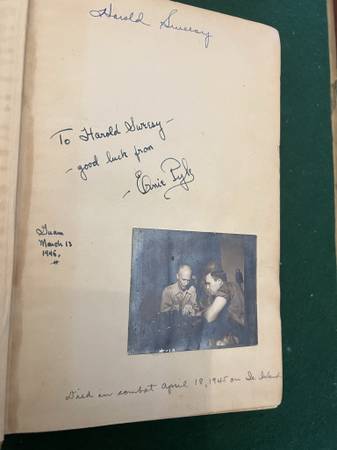
BRAVE MEN, SIGNED BY AUTHOR ERNIE PYLE, WITH REAL PHOTO RIGHT BEFORE HE DIED / 1944, 1ST ED, DJ
BOUGHT AT ESTATE
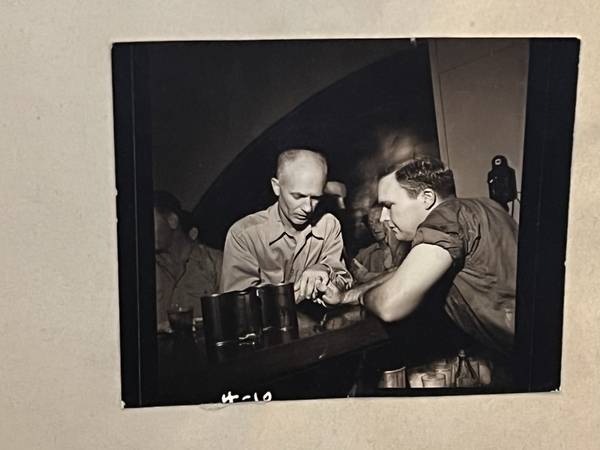
THERE IS A REAL PHOTO OF ERNIE PYLE GLUED UNDER THE SIGNATURE, I BELIEVE IT IS OF HERALD SWEESY AND ERNIE PYLE ON GUAM MARCH 13TH ONE MONTH BEFORE HIS DEATH. THIS IS A VERY RARE PHOTO AND LATE SIGNING FROM ERNIE PYLE AND TO HERALD SWEESY, GOOD LUCK-ERNIE PYLE
Ernest Taylor Pyle (August 3, 1900 – April 18, 1945) was a Pulitzer Prize–winning American journalist and war correspondent who is best known for his stories about ordinary American soldiers during World War II. Pyle is also notable for the columns he wrote as a roving human-interest reporter from 1935 through 1941 for the Scripps-Howard newspaper syndicate that earned him wide acclaim for his simple accounts of ordinary people across North America. When the United States entered World War II, he lent the same distinctive, folksy style of his human-interest stories to his wartime reports from the European theater (1942–44) and Pacific theater (1945). Pyle won the Pulitzer Prize in 1944 for his newspaper accounts of "dogface" infantry soldiers from a first-person perspective. He was killed by enemy fire on Iejima (then known as Ie Shima) during the Battle of Okinawa. At the time of his death in 1945, Pyle was among the best-known American war correspondents. His syndicated column was published in 400 daily and 300 weekly newspapers nationwide. President Harry Truman said of Pyle, "No man in this war has so well told the story of the American fighting man as American fighting men wanted it told. He deserves the gratitude of all his countrymen."
Pyle reluctantly headed for the Pacific theater in January 1945 for what became his final writing assignment. While covering the U.S. Navy and Marine forces in the Pacific, Pyle challenged the Navy's policy forbidding the use of the names of sailors in reporting the war. He won a partial but unsatisfying victory when the ban was lifted exclusively for him. Pyle travelled on board the aircraft carrier USS Cabot. He thought the naval crew had an easier life than the infantry in Europe, and wrote several unflattering portraits of the Navy. In response, fellow correspondents, newspaper editorialists and G.I.s criticized Pyle (who was a former member of the U.S. Naval Reserve) for his negative coverage of the Navy in his columns and for underestimating the difficulties of naval warfare in the Pacific. Pyle conceded that his heart was with the servicemen in Europe, but he persevered. After traveling to Guam and resuming his writing, Pyle went on to report on naval action during the Battle of Okinawa, the largest amphibious assault in the Pacific theater during World War II
Description: VG++ SIGNED WITH DUST JACKET, SEE PHOTOS / WHAT YOU SEE YOU GET